UNSW Embryology
|

|
RESPIRATORY
SYSTEM
|
Embryology Home
Page
|
|
|

|
|
Page
Links AbnormalitiesAustralian
Statistics 1981-1992Self
Assessment QuestionsOMIM
DatabaseRespiratory
TermsAbout
NotesNext
Page AbnormalitiesAustralian
Statistics 1981-1992Self
Assessment QuestionsOMIM
DatabaseRespiratory
TermsAbout
NotesNext
Page
|
Page
1 | Introduction
Page
3 | Pig
Stage 13/14
Page
4 | Human
(St 22) Trachea |
Human (st
22) Lungs
Page
5 | Selected
Human highpower
Text only
page | WWW
Links
|
DEVELOPMENTAL ABNORMALITIES
|
Oesophageal
Atresia
Lobar
Emphysema
Hyaline
Membrane Disease
Diaphragmatic
Hernia
Azygos
Lobe
|
|
|
TRACHEO-OESOPHAGEAL
FISTULA (OESOPHAGEAL ATRESIA)
OMIM
Database Entry- Tracheosophageal Fistula
OESOPHAGEAL ATRESIA-
with or without tracheo-oesophageal fistula
- International Classification of Diseases
code 750.3
- Australian national rate (1982-1992) 2.5 -
3.6 /10,000 births.
- Of 847 infants 9.9% were stillborn and 20.4%
liveborn died during neonatal period.
- 3 times as common in twin births than
singleton.
- Congenital Malformations Australia
1981-1992 P. Lancaster and E. Pedisich
ISSN 1321-8352
Summary
Oesophageal atresia as suggested by
(a) Polyhydramnios
(b) Reflex increase in salivation
(c) Holdup of the catheter confirmed by the
X-ray appearance of the dilated blind proximal
oesophagus. The fistula is confirmed by the
presence of gas in the intestines.
Management
1. Operative closure of the trachea end
of the fistula.
2. Restoration of the continuity of the
oesophagus
N.B. This is a serious malformation with
significant risk of mortality
Associated Malformations
(a) Stratified squamous epithelium and
columnar epithelia (mixtures of tracheal and
oesophageal epithelial) are found in the trachea
and oesophagus.
(b) This often occurs as one of a complex of
malformations in a child. The origin is in early
embryogenesis and often associated with
(i) cloacal malformation
(ii) cardiac septal defects
(iii) renal malformations
Questions
(a) The failure of what embryological
process might give rise to this malformation?
(b) Why is there almost invariable
association of tracheo oesophageal fistula with
polyhydramnios?
(c) Why is there an early onset of pneumonia
if the malformation is unrecognised?
(d) How might the defect possibly be
corrected?

|
LOBAR EMPHYSEMA
(Overinflated lung)
OMIM
Database Entry- Lobar Emphysema
1. There is an overinflated left upper
lobe
2. There is a collapsed lower lobe
3. The left lung is herniating across the
mediastinum
Description of lesion - there is a
congenital deficiency of cartilage in the left
upper lobe bronchus. The anatomical nature of the
lesion was demonstrated by autopsy specimens and
usually reveals no abnormality other than cartilage
deficiency throughout the lobe.
Summary
(a) Respiration is normal at first
(b) Once distress occurs overinflation is
rapidly progressive and may kill by
asphyxia.
(c) This is called Lobar Emphysema due to
congenital broncho-malacia (soft bronchi).
Management
The affected lobe must be resected.
|
RESPIRATORY
DISTRESS SYNDROME IN THE NEWBORN (Hyaline Membrane
Disease)
Management
1. R.D.S. is normally treated
conservatively with 02, intravenous bicarbonate
and general supportive measures but the
mortality rate is high in more premature
infants. At autopsy the principle change to be
seen is an eosinophilic hyaline membrane filling
the alveoli.
2. If the child is treated with constant
positive airway pressure this increases arterial
02 tension and helps prevent the collapse of
alveoli which deficient surfactant otherwise
causes. This increases the functional residual
capacity of the lungs. This support system is
effective in the nearly mature infants but the
more premature still have a high mortality
rate.
|
CONGENITAL DIAPHRAGMATIC
HERNIA
Failure of the pleuroperitoneal foramen (foramen
of Bochdalek) to close allows viscera into thorax.
Intestine, stomach or spleen can enter the pleural
cavity, compressing the lung.
- International Classification of Diseases
code 756.6
- Australian national rate (1982-1992) 2.1 -
3.8 /10,000 births.
- Congenital Malformations Australia
1981-1992 P. Lancaster and E. Pedisich
ISSN 1321-8352
|
AZYGOS LOBE
Common condition (0.5% of population). The right
lung upper lobe expands either side of the
posterior cardinal.
Management
Condition is generally harmless.
|
|
Australian Statistics
1981-1992
|
About Data
|
|
|
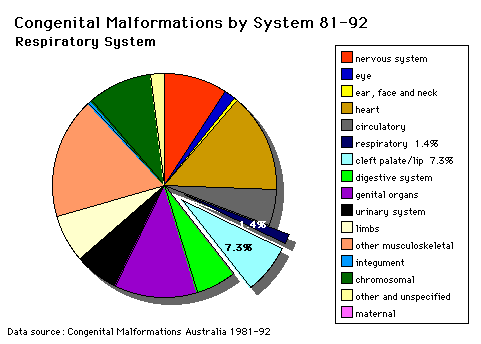
Data shown as a % of all Major Abnormalities
based upon published statistics using the same
groupings as CMA 81-92.
You can also see:
all the
statistical data as graphs
List of all Minor Abnormalities
|
|
|
|
Self Assessment
Questions
- How is the trachea formed and what are the
basic derivations of the lung?
- How does the thoracic cavity develop?
- What processes occur during the maturation
of the lung in the fetus?
- What is a tracheo-oesophageal fistula? How
does this affect the amount of amniotic fluid
present?
- How is the larynx formed?
|
|
PubMed
Database
Online Medline Database
PubMed-
Medline
National Library of Medicine (US) search service
to access the 9 million citations in MEDLINE and
Pre-MEDLINE (with links to participating on-line
journals), and other related databases.
Internet
Search this database or use the form below
with the keyword or related topics. You can also
restrict to reviews or by date published.
|
|
|
|
Respiratory Terms
- atresia-
obstruction.
- eppiglottis- develops from
hypobrachial eminence.
- laryngotracheal groove- forms on
anterior (ventral) wall of pharynx, gives rise
to larynx, trachea, respiratory tree
- lung buds- primordia of lungs.
- parietal pleura-outer lining of
pleural cavity derived from epithelia of
pericardioperitoneal canals from intraembryonic
coelom.
- pleural cavity- walls derived from
pericardioperitoneal canals -> intraembryonic
coelom ->coelomic spaces -> lateral
mesoderm -> mesoderm.
- pleuropericardial fold- restricts the
communication between pleural cavity and
pericardiac cavity, contains cardinal vein and
phrenic nerve.
- pleuroperitoneal membrane- forms
inferiorly at transverse septum to separate
peritoneum from pleural cavity.
- septum transversum- mesoderm
separating thoracic cavity and yolk sac, forms
central tendon of diaphragm (and some of
liver?).
- stenosis-
narrowing
- surfactant- a detergent secreted by
Type 2 alveolar cells between alveolar
epithelium. Functions to lower surface tension,
allowing lungs to remain inflated.
- visceral pleura- inner lining of
pleural cavity derived from contact epithelia
with lung bud of pericardioperitoneal canals
from intraembryonic coelom.
|
|
|
About Notes
- Lecture notes from the Anat 3311 1997
Science Embryology course compiled and written by Dr
Mark Hill. Some notes derived from historic
class notes.
- Note Links to OMIM Entries are copies of originals
for computers without internet access. Computers with
internet access can directly access the database.
|
|
|
m.hill@unsw.edu.au
Date Last Modified: 11/3/99
This site maintained by Dr M. Hill
|
|