|
A2,A3:
Otocyst, otic capsule, rhombencephalon and
rhombomeres.
A3,A4:
Trigeminal ganglion, dorsal end of 1st pharyngeal
arch, vestibulocochlear ganglion
(rostral to otocyst), superior glossopharyngeal
ganglion.
A4:
Large head vein lateral to otocyst.
Mesencephalon
A5:
Trigeminal ganglion, facial ganglion, large head
(superior (anterior) cardinal) vein lateral to
inferior (cut) end of otocyst, mesencephalon
(midbrain). 2nd pharyngeal arch.Vagus nerve in
lateral wall of superior cardinal vein.
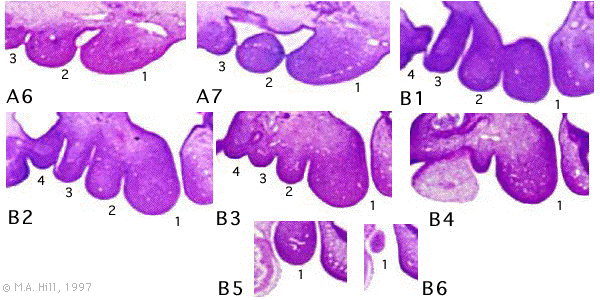
A6:
Midbrain, floor of hindbrain with 4th ventricle,
spinal cord, notochord. 1st, 2nd, 3rd pharyngeal
arches with 1st and 2nd pharyngeal pouches,
pharyngeal clefts. Trigeminal, facial, inferior
glossopharyngeal ganglia, vagus nerve.
A7:
4th arch with inferior vagal ganglion. Arch
arteries (cf. B 1, B2). Cut roof of pharyngeal
cavity in midline and laterally.
B1:
Division of 1st arch into mandibular and maxillary
components on one side (undivided on other side due
to alignment of embryo at sectioning). Dorsal
portion of hypopharyngeal hypo-branchial) eminence.
Prominent 3rd arch artery, dorsal aortae. Rathke's
pouch (derived from ectoderm anterior to the
buccopharyngeal membrane). prosencephalon.
Note thin pharyngeal pouch/groove membranes
B2:
Rathke's pouch. Dorsal part of pharyngeal cavity.
3rd arch artery. 4th arch artery joining to dorsal
aorta. 2nd and 3rd pouches with their corresponding
grooves. Optic cup and lens placode. Thyroid
rudiment (cords) near midline. Note that the
opening to the pharynx is located between B l and
B2 - the site of the former buccopharyngeal
membrane.
B3:
Aortic sac with emerging 3rd arch artery. Thyroid
cords. Arches l- 4. 4th arch arteries.
B4:
Aortic sac with emerging 4th arch artery.
Tangential section through optic stalk. Division of
first arch into mandibular and maxillary processes.
Pharynx. Note increasingly thick ectoderm of
pharyngeal arches.
B5:
Ventral ends of mandibular processes, maxillary
process on one side and nasal placode on other
side. Optic cup connected by optic stalk to wall of
forebrain (continuous lumen). Note that pharynx has
become compressed laterally (compare B4).
B6:
Note the ventral compression of the pharynx into a
plate and the dense mesenchyme laterally. Two atria
and midline truncus arteriosus of heart. Thick
nasal placode.
B7:
Glottis coming off pharyngeal foregut. Nasal
placode. Prosencephalon.
C1-C7:
Beginning of trachea, oesophagus. Nasal placodes
(nasal pit forming on one side). Forebrain. note
proximity of nasal pit to prosencephalon (future
site of olfactory nerve). In C2-C4, identify the
medial and lateral nasal swellings.
G7:
(Close to midline in head region). Forebrain,
midbrain, hindbrain (with thin roof). Rathke's
pouch. Floor of pharynx with foramen caecum (the
tongue has not yet formed). Aortic sac. Cephalic
flexure at side of midbrain between forebrain and
hindbrain. Cervical flexure at junction of spinal
cord and hindbrain.
G6:
Mandibular process of 1st arch. Pharyngeal aspect
of 1st, 2nd, 3rd arches. 3rd arch artery above
truncus arteriosus. Pharynx leading into
oesophagus. Ventral to oesophagus is the dense
mesenchyme laterally compressing the pharynx.
Notochord. Cephalic flexure and cervical
flexure.
|