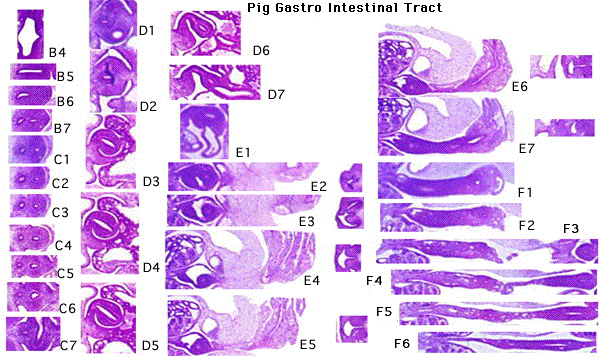
Introduction
The gastrointestinal tract (GIT) extending from
the pharyngeal membrane to the cloacal membrane
arises from the endoderm of the trilaminar embryo
(week 2, 3). During the 4th week the 3 distinct
portions (fore-, mid- and hind-gut) extend the
length of the embryo and will contribute different
components of the GIT. The large mid-gut is
generated by lateral embryonic folding which
"pinches off" a pocket of the yolk sac, the 2
compartments continue to communicate through the
villitine duct.
The hepatic diverticulum (liver bud) lies under
the septum transversum and is the earliest
associated GIT organ that has differentiated, and
will occupy a substantial region of the abdomen
during development.
Much of the midgut remains herniated at the
umbilicus external to the abdomen through
development. A key step in development is the
rotation of this midgut that must occur to place
the GIT in the correct abdominal position with its
associated mesentry. The GIT itself differentiates
to formsignificantly different structures along its
length: oesophagus, stomach, duodenum, jejunum,
iliem (small intestine), colon (large
intestine).
The mesentries of the GIT are generated from the
common dorsal mesentry, with the ventral mesentry
contributing to the lesser omentum and falciform
ligament.
The pancreas arises from 2 sources: the hepatic
diverticulum (ventral) and the duodenum (dorsal).
The pancreas must also differentiate to establish
specific cells for endocrine and exocrine
function.
The spleen arises in week 5 within the dorsal
mesogastrium as proliferating mesenchyme. Cells
required for its hemopoietic function arise from
the yolc sac wall. The spleen generates both red
and white cells in the 2nd trimester. Note that
embryonic RBCs remain nucleated.
|