UNSW Embryology

DEVELOPMENT OF THE HEART AND CARDIOVASCULAR SYSTEM

Embryology Home Page

Page 1 | 2 | 3 | 4 | 5 |WWW

Page LinksAbnormalitiesAustralian Statistics 1981-1992Self Assessment QuestionsOMIM DatabaseCardiac TermsAbout NotesNext PageText only page

Page 1 | Introduction
Page 3 | Pig Stage 13/14
Page 4 | Human (Stage22)
Page 5 | Selected Human highpower
Text only page | WWW Links

DEVELOPMENTAL ABNORMALITIES

PATENT DUCTUS ARTERIOSUS (P.D.A.)
Treatment. PDA is ligated simply and with little risk. The operation is always recommended even in the absence of cardiac failure. It can often be deferred until early childhood.

OMIM Database Entry- Patent Ductus Arteriosus (about this entry)

ATRIAL SEPTAL DEFECT (A.S.D.)
Treatment The surgical repair requires a cardiopulmonary bypass and is recommended in most cases of ostium secundum ASD, even though there is a significant risk involved. Ostium primum defects tend to present earlier and are often associated with endocardial cushion defects and defective mitral or tricuspid valves. In such cases, valve replacement may be necessary and the extended operation has a considerable chance of mortality.

OMIM Database Entry- Atrial Septal Defect (about this entry)

TETRALOGY OF FALLOT
Diagnosis. Tetralogy of Fallot by definition consists of:

(i) ventricular septal defect

(ii) pulmonary stenosis (valvular or infundibular)

(iii) (ii) results in an overriding aorta and

(iv) right ventricular hypertrophy

OMIM Database Entry- Tetralogy of Fallot (about this entry)

Ventricular septal defect

  • International Classification of Diseases code 745.4
  • Australian national rate (1982-1992) 13 - 18.8/10,000 births.
  • Of 4,141 infants 6.1% were stillborn and 13.1% liveborn died during neonatal period.
  • more common in twin births than singleton.

    Congenital Malformations Australia 1981-1992 P. Lancaster and E. Pedisich ISSN 1321-8352

Transposition of Great Vessels

Characterized by aorta arising from right ventricle and pulmonary artery from the left ventricle

  • International Classification of Diseases code 745.1
  • Australian national rate (1982-1992) 3.6/10,000 births.
  • Of 988 infants 4.1% were stillborn and 23.2% liveborn died during neonatal period.
  • slightly more common in twin births than singleton.

    Congenital Malformations Australia 1981-1992 P. Lancaster and E. Pedisich ISSN 1321-8352

Hypoplastic Left Heart

Characterized by obstructive valvular and vascular lesion of the left side of the heart.

  • International Classification of Diseases code 746.7
  • Australian national rate (1982-1992) 1.9-3.1/10,000 births.
  • Of 644 infants 4.8% were stillborn and 81.6% liveborn died during neonatal period.
  • slightly more common in twin births than singleton.

    Congenital Malformations Australia 1981-1992 P. Lancaster and E. Pedisich ISSN 1321-8352

OMIM Database Online Mendelian Inheritence in Man Database. OMIM

Internet Search this database with the keyword heart or the above abnormality names.

Note: This database is an external link, not accessible from some computers in the School of Anatomy.
A List of the search results for "Heart" is available for these computers.

Enter one or more search keywords:


To Search all fields, leave the following boxes unchecked. To narrow your search to certain specific fields, check the boxes next to those fields' names. See Query Help for other ways to search.
Title: OMIM Number: Allelic Variants: Text: References: Clinical Synopsis: Gene Map Disorder: Contributors:
See only records which have been changed in the past Display at most

Self Assessment Questions (C.V.S.)

1. How are red blood corpuscles formed in the fetus?

2. What are blood islands? How are primitive blood vessels formed?

3. What is the pericardium and how is it formed?

4. Briefly describe the development of the basic heart tube.

5. How is the auricle divided into L and R sides? What is incorporated in the final L atrium and R atrium?

6. How are the pulmonary veins formed?

7. Describe how the truncus arteriosus is divided into the pulmonary and systemic trunks.

8. What tissue forms the ventricular septum? How is the ventricular septum formed?

9. Where are atrial septal defects and ventricular defects found?

10. Define the limits of the foramen ovale.

11. Describe the aortic arches. Which aortic arches remain in the fetus and the adult?

12. What veins develop from the following in the fetus:

(i) Vitelline veins

(ii) Umbilical veins

(iii) Cardinal veins

13. What are the major consequences of P.D.A., A.S.D. and V.S.D. and tetralogy of Fallot on the individual with any of these malformations?

14. Compare and contrast malformations of the CVS which occur inside and outside the heart.

Australian Statistics 1981-1992

About Data

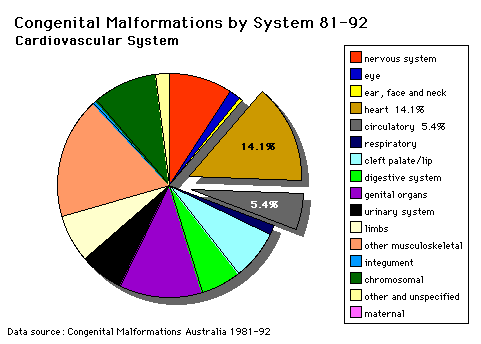
Data shown as a % of all Major Abnormalities based upon published statistics using the same groupings as CMA 81-92.

You can also see:

all the statistical data as graphs

List of all Minor Abnormalities

References

PubMed Database

Online Medline Database PubMed- Medline

National Library of Medicine (US) search service to access the 9 million citations in MEDLINE and Pre-MEDLINE (with links to participating on-line journals), and other related databases.

Internet Search this database or use the form below with the keyword heart or related topics. You can also restrict to reviews or by date published.

Search Field: Mode:

PubMed

PubMed Search Results Number as of March 1999.

  • Heart- 526,970
  • Heart and Review- 42,266
  • Heart and Development- 26,864
  • Cardiovascular- 125,018

About Notes

  • These lecture notes from the Embryology course compiled and written by Dr Mark Hill.
  • Note Links to PubMed Medline Entries are copies of originals for computers without internet access. Computers with internet access can directly access the database.
  • Note that reference lists are only relevant to the date that the original search was carried out.

Links

Serial Sections Homepage
Human Homepage
Pig Homepage

m.hill@unsw.edu.au
Date Last Modified: 11/3/99
This site maintained by Dr M. Hill