UNSW Embryology
|

|
DEVELOPMENT OF THE HEART AND
CARDIOVASCULAR SYSTEM
|
Embryology Home
Page
|
|
|

|
|
Page
Links IntroductionReading
Computer
Activities
ObjectivesLearning
activities Development
Overview Blood
flow through the Embryo Pig
OverviewTermsReferencesAbout
Notes IntroductionReading
Computer
Activities
ObjectivesLearning
activities Development
Overview Blood
flow through the Embryo Pig
OverviewTermsReferencesAbout
Notes
|
Page
2 | Abnormalities
| OMIM
| Questions
| Medline
Page
3 | Pig
Stage 13/14
Page
4 | Human
(Stage22) | Selected
Human highpower
Text only
page | WWW
Links
|
Introduction
The heart develops very early from cardiogenic
mesoderm that originally lies above the cranial end
of the developing neural tube. Enlargement of the
cranial neural fold brings this region ventrally to
its correct anatomical position. The original
paired cardiac tubes fuse, with the "ventricular"
primordia initially lying above the "atria". Growth
of the cardiac tube flexes it into an "S-shape"
tube, rotating the "ventricles" downward and
pushing the "atria" upward. This is then followed
by septation, a complex process which
converts this simple tube into a four chambered
heart. A key part of this process is the separation
of cardiac outflow (truncus arteriosus) into a
separate pulmonary and aortic arch outflow. During
embryonic development there is extensive
remodelling of the initially r/l symetrical
cardiovascular system and a contribution from the
neural crest to some vessels. Their are 3
aortic/venous circulatory systems: umbilical,
embryonic and vitelline. The umbilical
system is is lost at birth, the vitelline
contributes to the portal system and the
embryonic matures into the cardiovascular
system.
At birth there is a complete change with
activation of the pulmonary system (lungs) and
eventual closure of the channel between r. and l.
atria (foramen ovale).
The molecular mechanisms regulating cardiac
development are still largely unknown. Development
does appear to be an independent mechanism
preceding both skeletal and smooth muscle
development and using different regulatory
mechanisms (not MyoD or myogenin).
|
Reading
- Human Embryology (2nd ed.) Larson Ch7
p151-188 Heart, Ch8 p189-228 Vasculature
- The Developing Human: Clinically Oriented
Embryology (6th ed.) Moore and Persaud Ch14:
p304-349
- Before we Are Born (5th ed.) Moore and
Persaud Ch12; p241-254
- Essentials of Human Embryology Larson Ch7
p97-122 Heart, Ch8 p123-146 Vasculature
- Human Embryology Fitzgerald and Fitzgerald
Ch13-17: p77-111
- Additional
References
- Search PubMed-
Medline
|
Computer
Activities
UNSW
Embryology:
|
|
|
Embryo Images
Unit:
|
Early Cell Populations (cardiogenic
section), Cardiovascular System
Development
|
|
Objectives
- Describe the main features of heart
development to the four-chambered system.
- Describe the development of the
pericardium.
- Describe the development of primary and
secondary atrial septa and the ventricular
septum.
- Explain the changes occurring in the bulbis
cordis and truncus arteriosus in its
transformation from a single to a double
tube.
- Describe the development of the aortic
arches on the right and left sides from the
fetus to the adult.
- Describe the development of arteries and
veins.
- Describe the developmental aberrations
responsible for the following malformations:
patent ductus arteriosus (P.D.A.); atrial septal
defects (A.S.D.) and ventricular septal defects
(V.S.D.); tetralogy of Fallot.
|
Learning activities
- Review the developmental principles of the
C.V.S.
- Examine the models and diagrams of the
developing heart and list the main stages in
heart development.
- Examine microfiche cards of the 6mm pig and
8 week human embryos identifying the main
features of the C.V.S.
- Relate developmental principles of the heart
to the gross anatomy models.
- Introductory session on the development of
blood, blood vessels and lymphatics.
- Discuss the selected malformations P.D.A.,
A.S.D. and V.S.D. and tetralogy of Fallot giving
special reference to the developmental
aberrations causing the malformations and the
consequences of the malformations on the
individuals.
|
|
|

|
|
Development of the
Heart
- Week 2 pair of thin-walled tubes
- Week 3 tubes fused, truncus arteriosus
outflow, heart contracting
- Week 4 heart tube continues to elongate,
curving to form S shape
- Week 5 Septation starts, atrial and
ventricular
- Septation continues, atrial septa remains
open, foramen ovale
- Week 40 At birth pressure difference closes
foramen ovale leaving a fossa ovalis
|
|
Blood flow through
the Embryo
Maternal Blood | -> umbilical vein ->
liver -> anastomosis -> sinus venosus ->
atria ventricles-> truncus arteriosus ->
aortic sac -> aortic arches-> dorsal
aorta-> pair of umbilical arteries | Maternal
Blood
This is shown on the stage
13/14 pig G6 section.
|
|
|
Image
|
Description
|
|
|
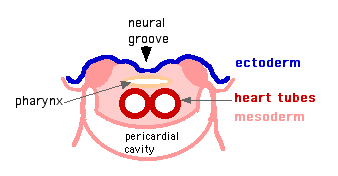
Transverse section
Heart is 2 tubes that fuse in the
midline anterioe to pharynx.
The pericardial cavity can be imagined
as the top of the "horseshoe" of the
intraembryonic coelom. (where the arms
become the pleural cavity and the ends
fuse anteriorly to form a single
peritoneal cavity).
|
|
|
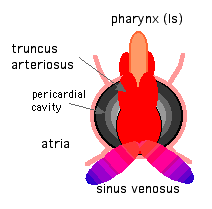
This view shows the initial positioning
of the ventricles above the atria. The
ventricles are rotated into their correct
anatomical position by the growth of the
heart tube, bending into an "S" shape.
Initially...
Cardiac inflow- at the bottom (sinus
venosus)
Cardiac outflow- at the top (truncus
arteriosus)
|

|
|
|
|
References
- Selected Lists of References from PubMed
March 1999 search results are available for
School of Anatomy computers without internet
access. Computers with internet access can
search from either Page
2 or PubMed
Internet Access
|
|
About Notes
- Lecture notes from the Anat 3311 1997
Science Embryology course compiled and written by Dr
Mark Hill. Some notes derived from historic
class notes.
- Note Links to OMIM Entries are copies of originals
for computers without internet access. Computers with
internet access can directly access the database.
|
|
|
m.hill@unsw.edu.au
Date Last Modified: 11/3/99
This site maintained by Dr M. Hill
|
|