Adhesion molecules - sequential involvement
Click picture to enlarge. Close window to return
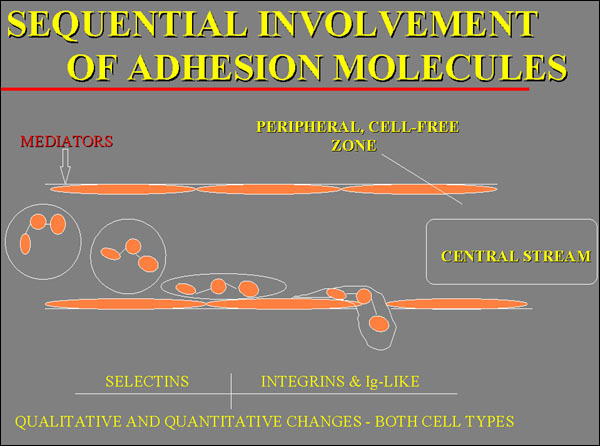
You have an excellent figure in your text (2-14) that depicts the events that are involved in emigration of leukocytes into the extravascular space. Cell adhesion molecules play an important role in this process. They are described in your text and under key words elsewhere in your computer program, so they won't be described here except to make several points that are not covered elsewhere. The first is that mediators cause both qualitative and quantitative changes in adhesion molecules, on the surfaces of both leukocytes and endothelial cells. Generally speaking, an adhesion molecule on one of the two cell types, i.e., either the leukocyte or the endothelial cell, has a receptor for it on the other cell type. Thus, they engage in a kind of lock-and-key relationship to increase intercellular adhesion. The second point is that there is sequential involvement of the families of adhesion molecules that are expressed on the surfaces of stimulated cells. The lectin-like adhesion molecules (selectins), for example, are more important in the early stages of adherence, with the integrins and immunoglobulin-like adhesion molecules being more important as adherence increases and leukocytes begin to crawl along the surfaces of the endothelial cells.