UNSW Embryology

DEVELOPMENT OF THE KIDNEY AND REPRODUCTION SYSTEMS

Embryology Home Page

Page 1 | 2 | 3 | 4 | 5 |WWW

Page LinksAbnormalitiesAustralian Statistics 1981-1992Self Assessment QuestionsOMIM DatabaseAbout NotesNext PageText only page

Page 1 | Introduction
Page 3 | Pig Stage 13/14
Page 4 | Human (Stage22)
Page 5 | Selected Human highpower
Text only page | WWW Links

DEVELOPMENTAL ABNORMALITIES

Note that upper G.I.T. obstruction is associated with POLYHYDRAMNIOS whereas failure of fetal micturition is associated with OLIGOHYDRAMNIOS with consequent firm uterine moulding on the fetus, leading to facial, locomotor and palatal deformities.The "figures" referred to below are on posters in the practical classroom.

RENAL AGENESIS

(a) In the complete form the child is not viable and the child dies within a few days of birth.

(b) Features associated with this anomaly are:-

(i)Oligohydramnios

(ii) Amnion nodosum (small warty amnion with accretions of squamous cells on the inner wall). This is tangible evidence for oligohydramnios.

(iii) Facial deformities: This results from uterine moulding around the head.

(Figure 1). The ears are low slung and simple, the mandible is small, the nose flattened and the eyes exhibit Pre-epicanthic folds (Figure 2). This is a horseshoe shaped flap of skin from the upper lid to the cheek in front of the epicanthus. (Downs syndrome has an epicanthic fold). Note that the genesis is occasionally incomplete allowing survival (e.g.) Figure 2. Causal factors are largely unknown although there is some familial predisposition.

POLYCYSTIC KIDNEYS

This is a diffuse cystic malformation of both kidneys with cystic malformations of the liver and lung etc. often being associated. There is often familial disposition with this malformation. There are TWO types

(i) Infantile (inconsistent with prolonged survival)

(ii) Adult (less severe and allows survival)

MULTICYSTIC KIDNEY

(i) This is non familial and is produced by atresia of a ureter

(ii) It is always unilateral

(iii) There is no functional kidney tissue present in the kidney

(iv) The kidney is replaced by a multiocular cyst.

URINARY TRACT OUTFLOW OBSTRUCTION

1. (e.g.) Urethral valves (Figure 9) - This figure is a micturating urethrogram and shows a valve obstruction (arrow) with dilatation of the urethra between the valve and the bladder. This type of pre-natal obstruction produces gross hydronephrosis and hydroureter before birth. Figure 10 shows gross dilatation of the pelves and ureters. There is extensive destruction of renal tissue.

2. Congenital Hydronephrosis is usually due to partial obstruction at the pelvi-ureteric junction (Figure 11). The pelvis is shown to be grossly dilated and there is extensive renal damage before birth.

*This may be familial, may be lateral, and is most commonly an intrinsic defect in the wall of the ureter (structural or functional). The less severe cases may be salvaged by reconstruction of the pelvi-ureteric junction.

PRUNE BELLY SYNDROME (Triad Syndrome)

The Triad is

(i) Agenesis of abdominal wall muscles

(ii) Bladder outflow obstruction

(iii) Bilateral undescended testes

 *The causes of this malformation are little known, but maternal therapy with Oestrogens in the first trimester has been implicated frequently.

Question: Does oestrogen possibly inhibit the development of the male bladder outflow and genital system?

In some cases there are vestiges of muscle in the abdominal wall and it is not known whether this represents

(a) destruction of muscle, or (b) failure of development of muscle

Figures 12 and 13 show a typical prune belly.

Survival of the prune belly child depends on the number of functioning remaining nephrons at birth and the operability of the obstruction.

HORSESHOE KIDNEY

In the horseshoe kidney there is fusion of the lower poles of the kidney.During migration from the sacral region the two metanephric blastemas can come into contact as shown in Figure 14 mainly at the lower pole. The ureters pass in front of the zone of fusion of the kidneys. The kidneys and ureters usually function adequately but there is an increased incidence of upper urinary tract obstruction or infection.

EXSTROPHY OF THE BLADDER

Management of Bladder Exstrophy

The deformity is non-familial, of no known cause and is obvious at birth. This malformation produced incontinence. The surgical reconstruction is complex and requires simultaneous repair of the bony pelvis and covering of the bladder and bladder neck. The epispadiac urethra is reconstructed later. (Ref. Snell, Clinical Embryology, p. 215, fig. 15-16).

Self Assessment Questions (C.V.S.)

  1. How does the kidney develop normally?
  2. At what level is the adult kidney found?
  3. What arterial changes take place during kidney development?
  4. Why does dye remain in the kidney in the IVP of an infantile polycystic kidney?
  5. How do children with non-functioning kidneys survive to birth?
  6. What problems confront the child with bladder exstrophy?

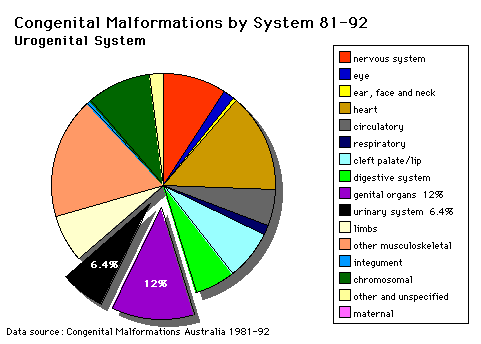
Australian Statistics 1981-1992

About Data

Data shown as a % of all Major Abnormalities based upon published statistics using the same groupings as CMA 81-92.

You can also see:

all the statistical data as graphs

List of all Minor Abnormalities

References

  • Selected Lists of References from PubMed March 1999 search results are available for School of Anatomy computers without internet access.
    •  
  • Computers with internet access can search from either Below or directly from PubMed Internet Access

PubMed Database

Online Medline Database PubMed- Medline

National Library of Medicine (US) search service to access the 9 million citations in MEDLINE and Pre-MEDLINE (with links to participating on-line journals), and other related databases.

Internet Search this database or use the form below with the keyword urogen or related topics. You can also restrict to reviews or by date published.

  • Note: This database is an external link, not accessible from some computers in the School of Anatomy.
  • A Selected List of References from March 1999 search results for "" and "" is available for these computers.

Search Field: Mode:

PubMed

PubMed Search Results Number as of March 1999.

About Notes

  • These lecture notes from the Embryology course compiled and written by Dr Mark Hill.
  • Note Links to PubMed Medline Entries are copies of originals for computers without internet access. Computers with internet access can directly access the database.
  • Note that reference lists are only relevant to the date that the original search was carried out.

Links

Serial Sections Homepage
Human Homepage
Pig Homepage

m.hill@unsw.edu.au
Date Last Modified: 11/3/99
This site maintained by Dr M. Hill