Cystic fibrosis
Click picture to enlarge. Close window to return
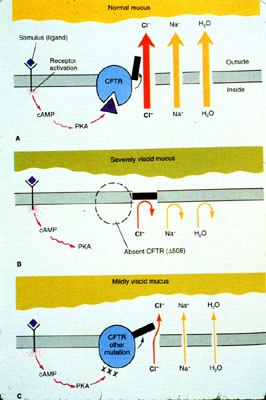
Molecular basis of decreased chloride secretion in mucus-producing epithelial cells. (A) In a normal person, the binding of an appropriate ligand to a surface receptor of a mucous cell, activates adenyl cyclase and elevates cAMP. cAMP then activates protein kinase A (PKA), which phosphorylates the cystic fibrosis transmembrane conductance regulator (CFTR). The activated CFTR is an open chloride channel in the plasma membrane. As a result, chloride ions are secreted into the extracellular mucus, which together with sodium ions and water, maintains the normal viscosity of mucus. In (B), persons with delF508 produce an incompletely glycosylaated mutant CFTR which is not transported to the plasma membrane, therefore stimulated Cl- secretion does not occur. As a consequence, the cell does not release Na+ and water, and the extracellular mucus is very viscid. In (C), patients with other mutations that produce a less severe CF, the mutant CFTR protein appears in the plasma membrane but is defective in response to cAMP. Cl- secretion is reduced but still present.