Granulomatous inflammation
Click picture to enlarge. Close window to return
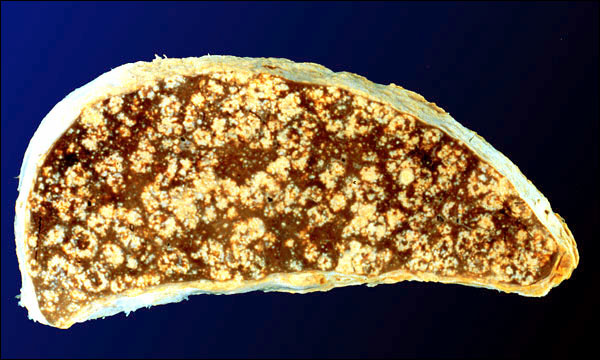
This is a cross section of a spleen from an individual with miliary tuberculosis. Tuberculosis is one of those diseases that has as its hallmark the formation of granulomas. The descriptive term, "miliary" stems from the fact that the granulomas here are very numerous and small, each one resembling a millet seed. You can discern the thick splenic capsule surrounding this piece of formalin fixed tissue, and the brown splenic pulp (it would be redder, were the tissue unfixed). The granulomas are the numerous cream-colored, roughly circular structures that are scattered throughout the splenic pulp. Microscopically, they would appear similar in their structure to the granulomas that are depicted in your text Fig. 2-25. The exception is that, in tuberculosis, the center of the granuloma is often necrotic (caseous necrosis), while in sarcoidosis, the granulomatous disease depicted in the text figure, they are non-caseating granulomas